A Deep Dive into Material Science, Thermal Efficiency, and Long-Term Durability for Pool Owners and Professionals.
Introduction: The Polyethylene Paradox
In the world of swimming pool maintenance, the “cover” is often an afterthought – a blue sheet thrown over the water. However, for industry professionals and informed homeowners, the pool cover is the single most critical component for energy conservation and safety.
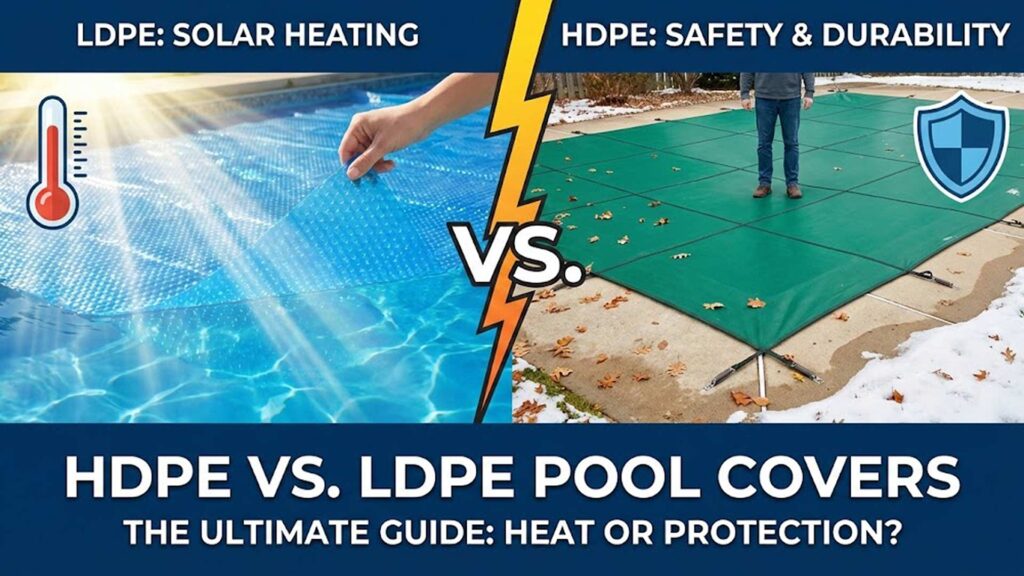
The market is bifurcated into two dominant materials: HDPE (High-Density Polyethylene) and LDPE (Low-Density Polyethylene). While both originate from the same monomer (ethylene), their processing creates two distinct materials with paradoxically opposite behaviors. One is designed to be a temporary, sacrificial thermal lens (LDPE), while the other is engineered as a permanent, structural shield (HDPE).
This guide moves beyond basic product descriptions to explore the polymer physics, manufacturing technologies, and real-world applications of these materials. Whether you are managing a commercial aquatic center or a backyard oasis, understanding these differences is the key to maximizing ROI and ensuring safety.
The Science of Plastic: Molecular Architecture
To truly understand why an LDPE cover floats and heats while an HDPE cover protects and lasts, we must look at the molecular level.
LDPE: The Branched Network (The “Spaghetti” Model)
Low-Density Polyethylene is created under high pressure (1000-3000 atm) using free-radical polymerization.
- The Structure: Imagine a tree with many unruly branches. In LDPE, the polymer chains have significant “long-chain branching.” These branches prevent the molecules from packing closely together in a crystal lattice.
- Density: Because the molecules cannot pack tightly, the material has a low density (typically 0.910 – 0.925 g/cm3).
- Physical Properties: The lack of crystallinity makes LDPE amorphous. This results in high ductility (stretchiness) and high transparency (clarity), but lower tensile strength. It is soft to the touch and flexible.
HDPE: The Linear Fortress
High-Density Polyethylene is produced using low-pressure coordination polymerization (often using Ziegler-Natta catalysts).
- The Structure: HDPE chains are linear, with very little branching. Imagine stacking uncooked spaghetti noodles; they align perfectly side-by-side.
- Density: This linear alignment allows for high crystallinity (packing density), resulting in a density of (0.941 – 0.965 g/cm3).
- Physical Properties: The high crystallinity makes HDPE rigid, opaque, and incredibly strong. It has high intermolecular forces, making it difficult to tear or puncture.
Technical Takeaway: LDPE is defined by flexibility and clarity (ideal for solar transmission). HDPE is defined by strength and opacity (ideal for physical protection).
Deep Dive: LDPE (Low-Density Polyethylene) Covers
Commonly known as “Solar Bubble Blankets” or “Floating Covers,” LDPE covers are the primary tool for active pool heating.

The “Solar Bubble” Mechanics
LDPE covers work on two physical principles: Transmission and Insulation.
- Transmission (Short-wave Radiation): The translucent LDPE allows short-wave solar energy to pass through the cover and strike the water/pool floor, converting into heat.
- Insulation (Air Gap): The bubbles (air cells) trapped between two layers of LDPE film act as an insulator. This reduces conductive heat loss from the water to the cooler air above.
Microns and Thickness: The Durability Correlation
LDPE covers are graded by thickness, usually measured in microns or mil (thousandths of an inch).
- Economy Grade (200-300 microns): Short lifespan (1-2 seasons). Prone to chemical attack.
- Premium Grade (400-600 microns): Higher resistance to chemical degradation. The thicker wall prevents chlorine from penetrating the bubble as quickly.
The “GeoBubble” Innovation:
Modern manufacturing has moved beyond simple round bubbles. The “GeoBubble” or “Figure-8” shape is designed to eliminate weak points. Round bubbles have thin corners where stress accumulates, leading to popping. The Figure-8 shape allows for uniform thickness, increasing the cover’s lifespan by up to 25%.
Color Science: Translucent vs. Aluminized
- Clear/Blue: Maximum solar transmission. Best for heating water quickly.
- Gold/Aluminized: These covers have reflective pigments. They are less effective at heating the water but superior at retaining heat by reflecting radiated heat back into the pool (acting like a thermos).
Deep Dive: HDPE (High-Density Polyethylene) Covers
Commonly known as “Winter Covers,” “Safety Covers,” or “Leaf Nets,” HDPE covers are structural fabrics.

Woven Strength: Warp and Weft
Unlike LDPE covers, which are extruded films, HDPE covers are woven.
- Tapes: HDPE is extruded into flat tapes.
- Weaving: These tapes are woven in a crisscross pattern (warp and weft).
- Lamination: For solid covers, the woven HDPE core is often laminated with a thin layer of LDPE on both sides to make it waterproof.
Safety Standards (ASTM F1346-91)
In the United States and many international markets, a true “Safety Cover” must meet ASTM F1346-91 standards. This requires the cover to hold a minimum weight (usually 485 lbs) to prevent a child or pet from falling through.
- Only HDPE has the tensile strength required to meet this standard. LDPE bubble covers are not safety covers; falling onto one is dangerous as the swimmer will become wrapped in the material (the “burrito effect”).
Solid vs. Mesh: The Filtration Debate
- Solid HDPE: Blocks 100% of sunlight and water. Keeps the pool clean but requires a pump to remove rain/melted snow from the top.
- Mesh HDPE: A looser weave that allows water to drain through while catching leaves.
- Pro: No puddling on top; lighter weight.
- Con: Allows fine silt and sunlight to enter, potentially causing algae growth in spring.
Head-to-Head Comparison: Performance Metrics
| Feature | LDPE (Solar Bubble) | HDPE (Woven Safety) |
| Primary Function | Heating & Evaporation Control | Safety & Debris Protection |
| Material Form | Extruded Film (Air Bubbles) | Woven Tapes (Fabric) |
| Tensile Strength | Low (10-15 MPa) | High (20-35 MPa ) |
| Tear Resistance | Poor (tears easily if snagged) | Excellent (Rip-stop weave) |
| UV Resistance | Moderate (requires additives) | Superior (naturally dense) |
| Chemical Resistance | Low (permeable to chlorine gas) | High (impermeable barrier) |
| Weight | Light (300-500 g/m2) | Heavy (150-250 g/m2 but large area) |
| Safety Rating | DANGEROUS (Entrapment hazard) | SAFE (ASTM Compliant) |
Chemical Resistance Analysis
Pool water contains oxidizers (Chlorine/Bromine). LDPE is susceptible to oxidative degradation. Chlorine ions attack the tertiary carbon atoms in the branched LDPE chains, causing “stress cracking” and bubble delamination. HDPE’s linear structure offers fewer attack points for oxidizers, making it significantly more chemically inert.
Geo-Specific Selection: Climate-Based Buying
Your location dictates your choice; here is how to choose based on geography.
Zone A: The Sun Belt (Arizona, Florida, Australia, Middle East)
- Challenge: Intense UV radiation and rapid evaporation.
- Recommendation:
- Summer: High-micron LDPE (500+) with heavy UV stabilization packages (HALS). Consider “CoolGuard” reflective covers to prevent the pool from becoming too hot.
- Winter: Generally not needed, or a light HDPE Mesh for leaves.
Zone B: The Snow Belt (Canada, Scandinavia, Northern US, Northern Europe)
- Challenge: Freezing cycles, heavy snow load, debris.
- Recommendation:
- Summer: Standard Blue LDPE to maximize short heating season.
- Winter: Solid HDPE Safety Cover. Mesh covers allow melted snow to refreeze in the pool, altering water levels. Solid HDPE handles the weight of snowpack without stretching permanently.
Zone C: Temperate/Rainy (UK, Pacific Northwest)
- Challenge: Heavy rain, algae growth due to intermittent sun.
- Recommendation: HDPE Mesh. Since rain is frequent, a solid cover becomes a maintenance nightmare (pumping water off). Mesh allows rain to pass through, reducing maintenance.
Economic Analysis: Total Cost of Ownership (TCO)
While an HDPE safety cover costs 5x-10x more upfront than an LDPE solar blanket, the TCO analysis tells a different story over a 10-year period.
Scenario: 10-Year Pool Ownership (Standard 16×32 Pool)
Option A: LDPE Strategy (Solar Only)
- Cost per cover: $150
- Lifespan: 2 years (optimistic)
- Replacements needed: 5
- Total Material Cost: $750
- Hidden Cost: Water and chemical loss due to lack of winter covering; risk of accidental drowning liability.
Option B: HDPE Strategy (Safety Only)
- Cost per cover: $1,200 (including anchors/installation)
- Lifespan: 12 years
- Replacements needed: 0
- Total Material Cost: $1,200
- Hidden Savings: Reduced insurance premiums (due to safety fence/cover); reduced spring opening costs ($200/year savings on chemicals/cleaning).
- Net 10-Year Value: Positive.
Expert Verdict: For strictly financial ROI on heating, LDPE wins. For asset protection and liability reduction, HDPE is the investment grade choice.
Installation and Maintenance Protocols
LDPE (Solar Cover) Care
- The Reel System: Always use a reel. Dragging LDPE on concrete (pool deck) abrades the bubbles, causing immediate failure.
- The “White Sheet” Rule: When the cover is rolled up on the reel, cover it with a white reflective HDPE sheet (usually provided). If left exposed on the reel, the layers magnify the sun like a magnifying glass, melting the plastic (a phenomenon called “solar prisming”).
- Chemical Shock: Never cover the pool immediately after shocking. Wait until chlorine drops below 3 PPM.
HDPE (Safety Cover) Care
- Spring Tension: HDPE safety covers rely on tension springs. Check these annually. If the springs are loose, the cover sags, and the safety rating is compromised.
- Rub Strips: Install padding (rub strips) anywhere the fabric touches coping or rough concrete to prevent abrasion.
Environmental Impact and Recyclability
In the age of sustainability, the environmental footprint of plastics is a major concern.
- Recycling Codes:
- HDPE is Code #2: It is one of the easiest plastics to recycle. Old safety covers can be washed, shredded, and pellitized to make pipes, lumber, or crates.
- LDPE is Code #4: It is recyclable but less accepted by curbside programs due to the difficulty of handling film/sheets (they jam machinery).
- Sustainability Factor:
- LDPE: By preventing evaporation, an LDPE cover saves up to 10,000 – 20,000 liters of water per year for an average pool. This water conservation outweighs the plastic waste generated by the cover itself.
- HDPE: Its longevity means less plastic enters the landfill over time compared to disposable solar covers.
Which Cover Should You Choose?
1. Purpose and Climate: If your main goal is debris protection and you live in a region with harsh winters or heavy rains, an HDPE tarp cover can be a cost-effective option. It will keep leaves and rain out but won’t heat the water. If you want to reduce heating bills and prevent evaporation – especially in sunny or cool climates – an LDPE bubble cover is usually better. In hot regions (e.g. Australia, California) solar (LDPE) covers are very popular for extending swim season.
2. Budget: HDPE tarps are cheaper upfront, so they fit tight budgets. LDPE solar covers are moderately priced, but you get energy/chemical savings in return. (Note: PVC/vinyl covers are a third option – more durable but much more expensive – with lifespans ~10 years.)
3. Installation: LDPE covers are lightweight and easy to roll on/off (often with a reel), which is convenient for daily use. HDPE tarps may require installation of anchors or water bags to secure around the pool.
4. Safety: Neither HDPE nor LDPE covers are true safety covers. They are not rated to hold weight. If child/pet safety is a concern, consider a safety cover (mesh or solid) that is specifically certified. However, HDPE tarps (if thick) may be slightly sturdier under snow load than thin LDPE bubbles, but neither should be relied on to support people.
5. Durability vs. Maintenance: LDPE bubble covers typically need replacing every 2–4 years under normal conditions, unless you invest in a high-end (500μm) bubble cover which may last 5–8 years. HDPE tarps (around 250–300 g/m²) generally last about 1–2 years in sun; thicker heavy-duty HDPE tarps can last longer but cost more. To prolong life, keep covers clean of debris and either store them or use UV-protectant products when not covering.
6. Environmental Impact: Both materials are polyethylene, a type of recyclable plastic. LDPE covers are marked #4 and can be recycled after use. HDPE is also recyclable (#2) and is considered a relatively eco-friendly plastic if reused.
Overall, there is no one-size-fits-all. An HDPE cover is ideal if you need an inexpensive weather barrier. An LDPE bubble cover is best if you want to capture solar heat and save on energy. Many pool owners use both: an LDPE cover daily for heat retention, and then a sturdier HDPE (or PVC) tarp for winter.
Conclusion and Final Verdict
The choice between HDPE and LDPE is not a competition; it is a selection of the right tool for the job.
- LDPE (Solar Covers) are the HVAC system of your pool. They actively generate heat, retain energy, and reduce running costs. They are lightweight, temporary, and focus on performance over longevity.
- HDPE (Safety Covers) are the Security System of your pool. They protect the water from contaminants and protect your family from accidents. They are heavy, permanent, and focus on durability and strength.
The Ideal Strategy:
For the ultimate pool experience, you need both. Use a high-micron LDPE cover during the swimming season to maintain 80°F+ water temperatures comfortably. When the season ends, clean and store the LDPE, and install a custom-fitted HDPE safety cover to protect your asset through the winter.
Frequently Asked Questions (FAQs)
Q: Can I leave my LDPE solar cover on during winter?
A: No. LDPE becomes brittle at freezing temperatures. Ice expansion will crush and pop the air bubbles. Furthermore, the weight of snow will sink the cover, rendering it useless and likely tearing it.
Q: Will an HDPE mesh cover heat my pool?
A: Minimally. While it prevents some evaporation, HDPE mesh blocks sunlight. A pool covered with HDPE mesh will generally be cooler than an uncovered pool exposed to direct sun.
Q: What is “Geotextile” underlayment?
A: This is a felt-like material often used under HDPE liners or covers to protect them from sharp rocks or rough ground. It is technically a non-woven polypropylene or polyester, distinct from the pool covers themselves.
Q: How do I repair a tear in these covers?
A:
- LDPE: Use a specific peel-and-stick patch made of UV-stabilized LDPE. Do not use duct tape; it will peel off in water.
- HDPE: Requires a sewn patch. Most manufacturers offer a patch kit where you glue a swatch of HDPE material over the hole using high-strength adhesive.
Q: Why is my solar cover disintegrating into blue flakes?
A: This is a sign of chemical oxidation and UV failure. The stabilizers in the plastic have been consumed. The cover is dead and must be discarded immediately to prevent the flakes from clogging your pump impeller.
Q: How long will an HDPE pool cover last?
A: A standard HDPE tarp cover typically lasts about 1–2 years under outdoor conditions. Heavy-duty HDPE covers may last longer if kept clean and not overloaded with water.
Q: How long will an LDPE bubble cover last?
A: A basic LDPE solar cover usually needs replacement every 1–3 years. Thicker “industrial” covers (e.g. 500 μm) with UV treatments can last 5–8+ years.
Q: Can I walk on these covers?
A: No. Neither HDPE tarps nor LDPE bubble covers are rated as safety covers. They are not built to support people. For child/pet safety, use a certified safety/security cover (mesh or solid) instead.
Q: Are these covers environmentally friendly?
A: Polyethylene (HDPE/LDPE) is recyclable. LDPE covers are marked resin code #4 and can be recycled when worn out. HDPE is resin code #2 and also recyclable. Reusing covers as ground tarps or pit liners can extend their life before recycling.
Q: How should I store my cover?
A: Keep it clean and dry. LDPE covers roll up on reels; HDPE tarps fold or roll. Store indoors or out of direct sun when not in use. This prolongs life by preventing mold and UV damage.
Q: What about safety vs. solar covers?
A: Solar (LDPE) covers are for heating and evaporation control, not safety. If you need a safety cover to prevent accidents, look for sturdy mesh or solid covers anchored around the deck; those are different from PE covers discussed here.