Imagine this scenario: You are a student sitting at a desk, deeply engaged in solving a complex algebraic equation. Your pen is moving across the paper, crunching numbers and carrying over remainders. But suddenly, in the back of your mind, a completely unrelated thought sparks. You start imagining the interior design of your future dream home. You mentally paint the walls, choose the fabric for the sofa, and arrange the lighting. Ten minutes pass. You look down, and you have successfully finished the math problem; yet, you have absolutely no active memory of doing it. Your focus had entirely shifted to your mental living room.
Or consider a second, equally common situation: You sit down to meditate or engage in a quiet, focused prayer. The goal is to clear your mind and be present. You close your eyes, regulate your breathing, and settle in. Out of nowhere, a thought pops up about a grocery run you need to make later. Before you know it, your focus has completely shifted. You are mentally walking down the aisles, picking out produce, and planning your dinner menu. You are completely unaware of your immediate physical surroundings, even though your body is still sitting in perfect meditative posture, breathing rhythmically, doing exactly what it was meant to do.
If you have experienced either of these situations, you are not alone. In fact, you are experiencing one of the most fascinating, sophisticated, and universally human cognitive phenomena in existence.
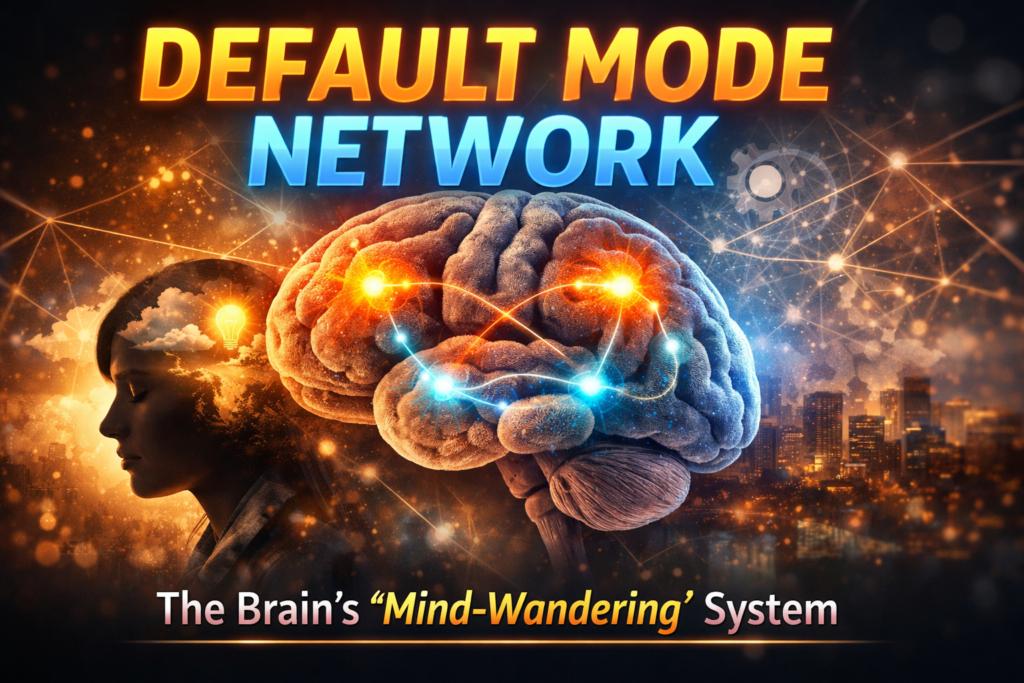
What exactly do psychologists and neuroscientists call this? It is the intersection of two powerful mental processes: Automaticity and Mind Wandering, heavily governed by a brain system known as the Default Mode Network.
In this comprehensive guide, we are going to dive deep into the neuroscience of the “autopilot brain.” We will explore why your mind splits its attention, how you can perform complex tasks without being consciously aware of them, and what this means for your everyday focus, productivity, and mental health.

The Phenomenon of “Automaticity” (The Autopilot)
To understand how you can solve a math problem or maintain a meditative breathing rhythm while consciously redecorating a house, we first have to understand the concept of Automaticity.
Automaticity is the ability to do things without occupying the mind with the low-level details required. It is the brain’s ultimate efficiency hack. It is the result of learning, repetition, habit, and muscle memory.
How the Brain Learns to Automate
When you first learn a new skill – whether it is riding a bicycle, driving a car, or solving a specific type of math equation – it requires 100% of your cognitive load. Your brain’s prefrontal cortex, which is responsible for executive function, active decision-making, and conscious focus, is working in overdrive. You have to actively think about keeping your balance on the bike, checking the rearview mirrors in the car, or remembering the formula for the math problem.
However, the human brain is an energy-hog. Although it only accounts for about 2% of your body weight, it consumes roughly 20% of your daily energy. To conserve energy, the brain is designed to turn repeated actions into automatic routines.
Once a task becomes familiar, the prefrontal cortex delegates the execution of that task to the basal ganglia, a region deep within the brain associated with habit formation, procedural learning, and routine behaviors.
The “Highway Hypnosis” Effect
When the basal ganglia takes over, the task becomes automatic. This frees up your conscious mind (your prefrontal cortex) to go do other things.
This is exactly why you can drive an incredibly complex machine (a car) down a busy highway at 65 miles per hour, navigate traffic, stay in your lane, and suddenly arrive at your destination with zero memory of the last ten miles of the trip. Your basal ganglia was driving the car. Your conscious mind was off daydreaming.
In Situation 1, the student had solved enough math problems that the mechanical act of writing and calculating became semi-automatic. In Situation 2, the physical posture and rhythmic breathing of meditation became an automatic routine. In both cases, the brain recognized that the immediate physical task was safe and routine, and it allowed the conscious mind to wander away.
The Science of Mind Wandering
If automaticity explains how your body keeps working, Mind Wandering explains where your conscious attention goes.
Mind wandering is formally defined in cognitive psychology as a shift in the contents of thought away from an ongoing task and/or from events in the external environment to self-generated thoughts and feelings. Colloquially, we call it daydreaming, spacing out, or being lost in thought.
We Spend Half Our Lives “Zoned Out”
You might think that mind wandering is an occasional distraction, but research proves otherwise. A landmark study published in the journal Science by psychologists Matthew Killingsworth and Daniel Gilbert utilized an app to track the thoughts of thousands of people throughout the day.
The results were staggering: The study revealed that people spend approximately 47% of their waking hours engaged in mind wandering.
Nearly half of your life is spent thinking about something other than what you are currently doing. Whether you are commuting, working, eating, or reading, your mind is constantly detaching from reality to explore internal landscapes, plan the future, or ruminate on the past.
The Engine Behind the Daydream: The Default Mode Network (DMN)
For a long time, scientists believed that when a person stopped actively focusing on a task, their brain simply powered down or rested. It wasn’t until the early 2000s, with the rise of functional magnetic resonance imaging (fMRI), that neuroscientists discovered something incredible.
When you stop focusing on the outside world, your brain does not shut down. Instead, a massive, interconnected network of brain regions suddenly lights up.
This system is known as the Default Mode Network (DMN): The Brain That Never Sleeps.
The Seesaw of the Brain
To understand how the DMN works in the context of our two situations, imagine that your brain has two primary operating systems that function like a seesaw:
- The Task-Positive Network (Executive Control): This is the network that activates when you need intense, conscious focus. It is the spotlight of your attention. When you are learning a brand new skill, reading a difficult document, or having an intense conversation, this network is turned on.
- The Default Mode Network (Task-Negative Network): This is your brain’s “background” mode. It is responsible for mind wandering, daydreaming, recalling past memories, imagining the future, and theory of mind (thinking about what other people are thinking).
Usually, these two networks are “anti-correlated.” When one is highly active, the other is suppressed. You cannot easily hold intense, novel focus on the outside world while simultaneously engaging in deep, introspective daydreaming.
What Happened in the Math and Meditation Scenarios?
In both situations described at the beginning of this article, the person started with their Task-Positive Network engaged. They were actively trying to do math, or actively trying to meditate.
However, as the task went on, it became repetitive. The brain realized, “I don’t need maximum executive control to do this anymore. I can put this on autopilot.” The moment the brain automated the physical task, the Task-Positive Network powered down. Like a seesaw tipping, the Default Mode Network immediately powered up. The DMN hijacked the person’s conscious awareness, plunging them into a vivid simulation of interior design or grocery shopping, while the basal ganglia kept the hands writing or the lungs breathing.
Normative Dissociation (When the Real World Fades Away)
In Situation 2 (the person praying or meditating), the person becomes “not aware of the happenings around them.”
When your mind wanders so deeply that you lose track of your physical surroundings, you are experiencing a psychological state called Normative Dissociation.
The word “dissociation” often carries negative connotations, as it is frequently discussed in the context of trauma, PTSD, or severe psychiatric disorders. However, normative dissociation is a completely healthy, common, and harmless human experience.
It is the experience of temporarily losing touch with your immediate environment because your internal, self-generated world (powered by the DMN) has become more vivid, demanding, and engaging than your external reality.
Common examples of normative dissociation include:
- Reading a book: Moving your eyes down an entire page, reading every word, but realizing at the bottom that you have no idea what you just read because you were thinking about an argument you had yesterday.
- Listening to a lecture: Staring directly at a speaker, nodding along, but actually planning what you are going to watch on Netflix later.
- Showering: Staring blankly at the shower wall while having a deeply emotional, imaginary argument with your boss.
In these moments, your sensory organs (eyes, ears) are still receiving data, but your conscious brain is simply ignoring the data in favor of the daydream.
Why Did Evolution Program Us to Zone Out?
It might seem like a major biological flaw that humans cannot just focus on the task at hand 100% of the time. Why would evolution program our brains to zone out, dissociate, and daydream? Wouldn’t a prehistoric human who zoned out while hunting get eaten by a tiger?
As it turns out, the ability to mind-wander is actually one of humanity’s greatest evolutionary advantages. It is tied to several crucial survival traits.
1. Mental Time Travel and Future Planning
Humans are arguably the only species on Earth capable of “mental time travel.” We can vividly project our consciousness into the future.
When the student in Situation 1 is designing a home, or the meditator in Situation 2 is planning a grocery trip, their brain is running simulations. By imagining the future, we can anticipate problems, prepare solutions, and organize our lives before events actually happen. This ability to plan ahead is what allowed early humans to survive winters, store food, and build complex societies.
2. Creative Incubation and Problem Solving
Have you ever noticed that your best ideas—the sudden “Aha!” moments—rarely come to you when you are intensely staring at a computer screen? Instead, they hit you when you are doing the dishes, taking a walk, or standing in the shower.
This is the Default Mode Network at work. When you stop intensely focusing on a specific problem, your mind wanders. As it wanders, the DMN begins connecting disparate, seemingly unrelated pieces of information stored in your brain. It bridges gaps that your logical, focused mind could not cross, resulting in sudden bursts of creativity and insight.
3. Cognitive Rest and Recovery
Intense, directed attention is a finite resource. It causes a phenomenon known as Directed Attention Fatigue. If you force your brain to focus on a spreadsheet or a textbook for hours on end, your cognitive performance will severely degrade.
Mind wandering acts as a cognitive pressure valve. By slipping into a daydream, your brain allows its executive functioning centers to rest and recharge, ensuring you have the mental energy to focus later when a true emergency or complex task arises.
When Does Mind Wandering Become a Problem?
While building mental houses and planning grocery trips is completely normal, there is a point where the autopilot brain can become detrimental to a person’s quality of life.
It is important to distinguish between healthy mind wandering, ADHD-related inattention, and a condition known as Maladaptive Daydreaming.
1. Attention-Deficit/Hyperactivity Disorder (ADHD)
For individuals with ADHD, particularly the inattentive type, regulating the “seesaw” between the Task-Positive Network and the Default Mode Network is incredibly difficult. Their brain struggles to suppress the DMN when it is time to focus. As a result, they may find themselves slipping into autopilot far more frequently and aggressively than neurotypical individuals, making it severely difficult to complete schoolwork, maintain conversations, or finish professional tasks.
2. Maladaptive Daydreaming
Coined by clinical psychologist Professor Eli Somer in 2002, Maladaptive Daydreaming is a psychological condition where a person experiences highly structured, deeply immersive, and compulsive daydreams that can last for hours at a time.
Unlike the spontaneous grocery-planning of normal mind wandering, maladaptive daydreams often involve complex, fantasy-driven plots, recurring characters, and intense emotional attachments.
Signs that daydreaming may be maladaptive rather than normative:
- The daydreaming is triggered compulsively by music, movies, or pacing.
- The individual makes unconscious facial expressions, whispers, or acts out the daydream physically.
- The internal fantasy world is vastly preferred over real life, acting as a coping mechanism for trauma, depression, or profound loneliness.
- The daydreaming severely interferes with relationships, hygiene, academics, or employment.
If you find that you cannot stop your mind from wandering, and it is causing significant distress in your daily life, it is highly recommended to speak with a licensed mental health professional or therapist.
Strategies to Snap Out of Autopilot
If you are experiencing normal mind wandering but find it incredibly annoying – perhaps you are trying to study for a crucial final exam, or you genuinely want to experience a deep, focused meditation – how do you pull yourself back to reality?
Because automaticity and the Default Mode Network are so powerful, you cannot simply “will” your brain to stop thinking. However, you can use neuroscience-backed strategies to hijack your own attention and forcefully turn the Task-Positive Network back on.
1. The Mindfulness “Notice and Name” Technique
In meditation practices, the goal is almost never to stop thoughts from occurring. That is biologically impossible. The goal is to catch the mind wandering faster.
When you are praying or meditating and realize you are suddenly in the grocery store aisle, do not get frustrated. Frustration engages emotional centers of the brain that cause further distraction. Instead, simply “Notice and Name” it. Silently say to yourself, “Thinking,” or “Planning.” The mere act of identifying and categorizing the thought forces your prefrontal cortex to activate. This immediately suppresses the Default Mode Network and brings you back to the present moment.
2. Increase the Cognitive Load
Your brain only goes on autopilot when a task is easy enough to be automated. If you are reading a textbook and keep zoning out, the task isn’t demanding enough of your brain’s active resources. You need to increase the cognitive load.
- Read out loud: This requires visual tracking, vocal cord manipulation, and auditory processing. It demands too much bandwidth for the DMN to take over.
- Annotate actively: Do not just highlight text. Write summaries in the margins. Engage your critical thinking skills.
3. Sensory Grounding (The 5-4-3-2-1 Method)
If you find yourself completely dissociated in a daydream and need to quickly anchor yourself back into reality, use your physical senses. Look around the room and identify:
- 5 things you can see.
- 4 things you can physically feel (the texture of your clothes, the temperature of the air).
- 3 things you can hear.
- 2 things you can smell.
- 1 thing you can taste. This floods your brain with immediate, external sensory data, forcing it to abandon the internal simulation.
4. Schedule “Wandering Time”
If your brain is desperate to plan the future or design a mental house, give it permission to do so – on your terms. Schedule 15 to 20 minutes a day for a “mind wandering walk.” Leave your phone, music, and podcasts behind. Walk outside and intentionally let your mind go wherever it wants. By giving the Default Mode Network an active, scheduled outlet, it is less likely to aggressively interrupt you when you are trying to do math or meditate.
Conclusion: Embrace Your Multitasking Brain
The next time you catch yourself solving a complex problem while simultaneously picking out throw pillows for an imaginary mansion, do not be angry with yourself for losing focus.
Instead, take a moment to marvel at the sheer processing power of your own mind. Your brain is a biological supercomputer, capable of flawlessly executing complex, learned behaviors in the physical world while simultaneously rendering entirely new, vivid realities in your conscious mind.
Mind wandering and automaticity are not signs of a weak intellect or a broken attention span. They are the hallmarks of a highly evolved, creative, and remarkably efficient human brain. The trick is simply learning how to recognize when you are on autopilot, and knowing how to grab the steering wheel when you finally need to drive.