Introduction: The Brain That Never Sleeps
For decades, we imagined the brain worked like a light switch. When you were solving a math problem or navigating a busy street, the switch was “ON.” When you were daydreaming on the couch or spacing out in a meeting, the switch was “OFF.”
We were wrong.
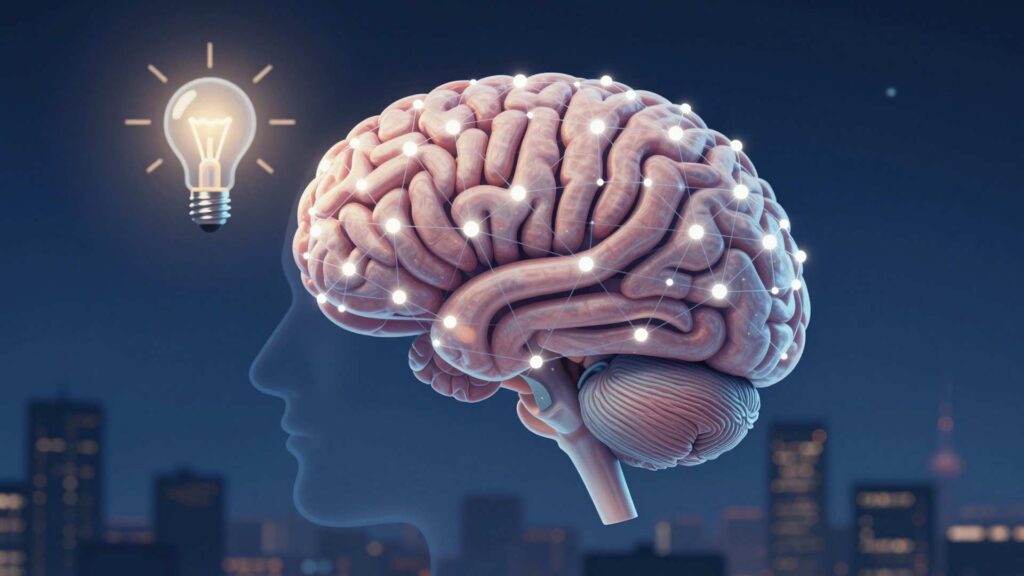
In the early 2000s, neuroscientists stumbled upon a startling discovery that overturned our understanding of consciousness. They found that when you stop “doing” and start “being”; when you let your mind wander, recall a memory, or think about yourself – your brain doesn’t power down. Instead, a massive, interconnected network of brain regions lights up like a Christmas tree. This system consumes 20% of your body’s energy, even when you feel like you’re doing absolutely nothing.
This is the Default Mode Network (DMN).
Think of the DMN as your brain’s “screensaver.” But unlike a computer screensaver that just prevents burn-in, this one is actively writing your autobiography, planning your future, and decoding the social world around you. It is the neurological basis for your sense of “self”; the narrator in your head that calls itself “I.”
In this comprehensive guide, we will explore what the Default Mode Network is, why it is critical for your mental health, how it fuels creativity, and perhaps most importantly, how you can learn to control it to reduce anxiety and find peace.
Key Takeaway: The Default Mode Network (DMN) is a group of brain regions that are most active when you are not focused on the outside world. It is responsible for self-referential thought, daydreaming, and memory.
The Accidental Discovery: How Science Found the “Self” in the Noise
The story of the DMN is one of the happy accidents of science. Until the late 1990s, brain imaging studies (like fMRI and PET scans) were designed to measure activity during specific tasks. If a researcher wanted to know which part of the brain controlled vision, they would show a subject a flashing checkerboard and subtract the brain activity recorded during “rest” (staring at a blank crosshair).
The assumption was that the “resting” brain was quiet, a baseline of zero.
The “Noise” That Wouldn’t Go Away
Dr. Marcus Raichle, a neurologist at Washington University in St. Louis, noticed something peculiar. When subjects were in the “resting” phase of these experiments, lying in the scanner doing nothing, certain areas of the brain were more active than during the difficult tasks.
Time and time again, when the cognitive task began (like solving a puzzle), activity in these specific regions would drop. When the task ended, the activity would surge back up.
Raichle realized this wasn’t just “neural noise.” It was a distinct, organized system. In a landmark 2001 paper, he coined the term “Default Mode,” suggesting that the brain has a baseline state of high activity that is suspended only when we need to focus on the external world.
Why “Dark Energy”?
Raichle later referred to this as the brain’s “dark energy.” Despite the brain accounting for only 2% of body weight, it consumes 20% of the body’s energy. Remarkably, task-related activity (like reading this sentence) increases that energy consumption by less than 5%. The vast majority of the brain’s energy budget is dedicated to maintaining this “default” state.
This discovery shifted the paradigm of neuroscience. We moved from viewing the brain as a reflexive organ (input -> output) to an intrinsic one (constantly generating its own predictions and simulations).
Anatomy of the Ego: A Tour of the Default Mode Network
To understand how the DMN influences your thoughts, we must look at its physical components. The DMN is not a single spot in the brain; it is a “network” – a collection of distant regions that fire in sync, connected by thick highways of white matter.
The primary “hubs” of the DMN can be divided into three main sections:
A. The Medial Prefrontal Cortex (mPFC)
- Location: The front middle part of your brain, just behind your forehead.
- Function: This is the center of the “Self.” The mPFC is heavily involved in self-referential processing – thinking about me, my traits, my history, and my feelings. It also plays a key role in social cognition, helping us infer what others are thinking (Theory of Mind).
- The “Me” Factor: If you read the word “happy,” your language centers light up. If you read the question “Am I happy?”, your mPFC lights up.
B. The Posterior Cingulate Cortex (PCC) & Precuneus
- Location: Deep in the middle of the brain, towards the back.
- Function: The PCC is the central “hub” or traffic controller of the DMN. It is highly connected to other brain networks. It is involved in retrieving autobiographical memories (episodes from your life) and imagining future scenarios.
- The “Time Travel” Factor: When you close your eyes and vividly remember your 10th birthday, or imagine what you’ll do next summer, the PCC and Precuneus are hard at work.
C. The Angular Gyrus (Inferior Parietal Lobule)
- Location: On the side of the brain, near the back and top.
- Function: This region connects perception, attention, and language. In the context of the DMN, it helps integrate information to create a coherent narrative. It allows you to read a sentence and understand the deeper meaning or context, and it connects your personal memories to general facts about the world.
D. The Hippocampus (in the Temporal Lobe)
- Location: Deep inside the temporal lobes, shaped like a seahorse.
- Function: While often considered part of the memory system, the hippocampus talks constantly with the DMN. It provides the “raw material” (memories) that the DMN uses to construct your sense of self and simulate the future.
Summary of Anatomy:
- mPFC: The “Me” center.
- PCC: The “Time Travel” center.
- Angular Gyrus: The “Meaning” maker.
- Hippocampus: The “Librarian” of memories.
The Three Pillars of Function: What the DMN Actually Does
So, why does your brain spend so much energy on this network? Evolutionary biologists believe the DMN provided early humans with a survival advantage by allowing them to learn from the past and plan for the future.
The functions of the DMN can be grouped into three main pillars:
Pillar 1: Self-Referential Thought (The “Autobiography”)
The DMN creates the narrative of who you are. It strings together your memories, your beliefs, and your future goals into a cohesive story.
- Example: When you think, “I am a person who likes coffee but hates loud noises,” that is your DMN constructing your identity.
Pillar 2: Mental Time Travel (The Simulator)
Humans are unique in their ability to detach from the present moment. The DMN allows you to “travel” in time.
- Retrospection (Past): Replaying a conversation from yesterday to analyze what went wrong.
- Prospection (Future): Simulating a job interview next week to prepare your answers.
- Why it matters: This simulation capability allows us to “test” actions without the risk of actually doing them, a massive evolutionary perk.
Pillar 3: Social Cognition (Theory of Mind)
The DMN is active when we think about other people. Because we understand others by projecting our own feelings onto them, the “self” network is also the “empathy” network.
- Theory of Mind: The ability to understand that others have beliefs, desires, and intentions different from your own.
- Social Navigation: Figuring out your status in a group, understanding moral dilemmas, or judging someone’s character.
Note: The DMN is not active when you are reacting to a sudden loud noise or solving a math problem. It is the network of introspection.
The Great Seesaw: Default Mode vs. Task Positive Networks
To understand focus, you must understand the “anticorrelated” relationship between the DMN and the Task Positive Network (TPN).
The TPN (sometimes called the Executive Control Network or Dorsal Attention Network) activates when you are engaged in a demanding, external task. This includes activities like:
- Doing mental arithmetic.
- Playing a fast-paced sport.
- Listening intently to a lecture.
- Navigating complex traffic.
The Seesaw Mechanism
In a healthy brain, these two networks operate like a seesaw.
- TPN Up, DMN Down: When you focus on a task, your DMN should quiet down. You “lose yourself” in the work.
- DMN Up, TPN Down: When the task is over, the TPN relaxes, and the DMN boots up again to process what just happened.
What Happens When the Switch Fails?
Problems arise when this seesaw gets stuck or “leaky.”
- The “Leaky” DMN: If you are trying to read a book (TPN task) but your DMN refuses to shut up (worrying about dinner, replaying a fight), you experience distraction or brain fog.
- Interference: High DMN activity during tasks is strongly correlated with errors. If you’ve ever walked into a room and forgotten why, it’s likely your DMN (daydreaming) overpowered your TPN (attention).
The Dark Side of the Loop: When the Network Goes Rogue
While the DMN is essential for a healthy sense of self, an overactive or dysregulated DMN is a hallmark of nearly every major mental health disorder.
Depression: The Trap of Rumination
In major depressive disorder, the DMN is often hyperactive and hyper-connected.
- The Mechanism: Instead of “wandering,” the mind gets stuck in a repetitive loop of negative self-referential thought. This is called rumination.
- The Thought Loop: “Why did I say that? I’m such a failure. This always happens to me.”
- The Science: Studies show that in depressed patients, the mPFC (Self) fails to decouple from the amygdala (Emotion). The DMN essentially traps the person in a painful past or a hopeless future, unable to engage with the present moment (TPN).
Anxiety: The Future-Simulator from Hell
While depression often looks back, anxiety often looks forward. An overactive DMN in anxiety disorders is constantly running “catastrophe simulations.”
- The Mechanism: The “Mental Time Travel” function of the DMN goes into overdrive, predicting worst-case scenarios to prepare for threats that don’t exist.
Schizophrenia: The Broken Filter
In schizophrenia, the “seesaw” between the DMN and TPN is broken. The boundary between internal thought (DMN) and external reality (TPN) blurs.
- The Consequence: The internal voice is perceived as external (hallucination), and the sense of self becomes fragmented.
Alzheimer’s Disease
Interestingly, the regions of the brain that make up the DMN are the first to be attacked by Alzheimer’s disease.
- Amyloid Plaques: The sticky proteins that cause Alzheimer’s tend to accumulate specifically in the hubs of the Default Mode Network (PCC and Precuneus).
- The Result: This explains why the first symptoms are often memory loss (hippocampus) and a loss of self-identity (mPFC).
The Creative Spark: Why the DMN is Essential for Innovation
It would be a mistake to view the DMN as the villain. It is also the source of human genius.
Have you ever struggled with a problem all day, only to have the solution pop into your head while you were in the shower or driving home? That is the DMN at work.
The Incubation Effect
When you are intensely focused on a problem (TPN activity), your brain is often too “zoomed in” to see novel connections. You are looking for the answer in the places you expect to find it.
- Letting Go: When you take a break, the TPN relaxes, and the DMN takes over.
- Associative Thinking: The DMN is looser and more associative. It scans distant memories, abstract concepts, and seemingly unrelated ideas.
- The “Eureka” Moment: The DMN finds a connection between two disparate ideas and hands it back to the executive network.
Divergent Thinking
Psychological research distinguishes between convergent thinking (finding the one correct answer – TPN) and divergent thinking (generating many possible uses for a brick – DMN). High creativity often involves a unique ability to rapidly switch between the DMN (generating wild ideas) and the TPN (evaluating and executing them).
Key Takeaway: Daydreaming is not laziness; it is distinct cognitive work. A healthy DMN is essential for creativity, problem-solving, and consolidating new skills.
Taming the Monkey Mind: How to Regulate Your Default Mode Network
Since an overactive DMN is linked to unhappiness (a Harvard study famously titled “A Wandering Mind is an Unhappy Mind” confirmed this), learning to regulate this network is a superpower for mental health.
Here are evidence-based methods to “quiet” the DMN.
A. Mindfulness and Meditation
Meditation is the direct training of the DMN/TPN seesaw.
- Focused Attention (Breathwork): When you focus on your breath, you activate the TPN. When your mind wanders (DMN activates), you catch it and return to the breath (reactivating TPN). This is “reps” for your brain.
- Open Monitoring: This involves observing the DMN without getting sucked into it. You watch thoughts pass like clouds.
- The Evidence: fMRI scans of long-term meditators show significantly reduced activity in the DMN and, crucially, less “stickiness” in the DMN even when they aren’t meditating. They can snap out of rumination faster.
B. Flow States
“Flow” is a psychological state of complete absorption in an activity (coding, painting, skiing, playing music).
- The Mechanism: During Flow, the DMN shuts down almost completely. The “self” disappears. You lose track of time.
- The Benefit: This provides a massive relief from anxiety and rumination. The “inner critic” (mPFC) is silenced.
C. Psychedelic Therapy (The “Reset”)
Recent research into psilocybin (magic mushrooms) and LSD has revealed their profound effect on the DMN.
- The “Entropy” Theory: Psychedelics appear to temporarily disintegrate the connections within the DMN. The strict hierarchy of the brain collapses, allowing regions that usually don’t talk to each other to communicate.
- Ego Dissolution: Subjectively, this feels like the “death of the ego” or a sense of oneness with the universe.
- Therapeutic Potential: By shaking up a rigid DMN (common in depression), psychedelics may allow the brain to “reset” into healthier patterns. (Note: This is clinical research, not medical advice).
D. Cognitive Behavioral Therapy (CBT)
CBT is essentially a manual override for the DMN.
- Reframing: It trains you to catch the “automatic negative thoughts” generated by the DMN and challenge them using the logical TPN. Over time, this rewires the default predictions your brain makes.
The Future of Neuroscience: What’s Next for the DMN?
As imaging technology improves, our understanding of the DMN is becoming more nuanced.
Subsystems of the DMN
We now know the DMN isn’t just one blob. It has at least two subsystems:
- The Dorsal Subsystem: Involved in social cognition and thinking about others.
- The Medial Temporal Subsystem: Involved in memory and future simulation. Understanding these distinctions could lead to targeted treatments. For example, a drug could specifically target the “rumination” circuit without dampening the “creativity” circuit.
Biomarkers for Mental Illness
In the future, doctors might not just ask “How do you feel?” to diagnose depression. They might take a “resting state functional connectivity” scan. If they see hyper-connectivity in the posterior cingulate cortex, they will have a biological marker for the disease, leading to more precise treatments.
Conclusion & Key Takeaways
The Default Mode Network is the physiological basis of your inner life. It is the narrator that tells you the story of you. It allows you to learn from the past, plan for the future, and empathize with others. It is the seat of creativity and the cradle of the ego.
However, like any powerful tool, it requires management. Left unchecked, the DMN can become a source of chronic worry and regret, trapping us in loops of unhappiness.
The secret to a balanced mind is not to destroy the ego or silence the DMN forever, but to gain the flexibility to switch it off when it’s not serving us. By practicing mindfulness, engaging in deep work (Flow), and understanding the mechanics of our own minds, we can turn the DMN from a harsh master into a useful servant.
Summary Checklist: Do You Understand the DMN?
- What is it? The network active during rest/daydreaming.
- What does it do? Self-reflection, memory, future planning.
- The Seesaw: It opposes the “Task Positive Network” (focus).
- The Danger: Overactivity leads to depression and anxiety.
- The Solution: Meditation, Flow, and engagement with the present moment regulate it.
Frequently Asked Questions (FAQ)
Q: Is the Default Mode Network bad? A: No. It is essential for memory, planning, and creativity. It is only “bad” when it becomes hyperactive and leads to obsessive negative thinking (rumination).
Q: Does meditation turn off the DMN? A: Yes, during the act of focused meditation, DMN activity decreases. Long-term practice gives you better control over turning it down in daily life.
Q: Can I damage my DMN? A: Drug abuse, chronic stress, and lack of sleep can disrupt the healthy functioning of the DMN. Conversely, healthy habits like exercise and sleep restoration can repair it.
Q: Is DMN activity the same as the subconscious? A: Not exactly. The DMN is often conscious (you are aware you are daydreaming). The subconscious controls things like heart rate or learned muscle movements, which are handled by different brain structures.